


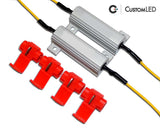

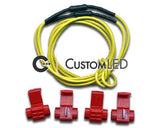

You may have heard the term "Load Equalizer" or "Load Resistor" being thrown around when looking for a solution to your fast-blink or no-blink issues on your motorcycle. The fast blink issue occurs when you remove the OEM incandescent blinker lamps and replace them with LEDs.
Well, understanding what a Load Equalizer is, starts by understanding why you need one in the first place.
Why do I need a Load Equalizer?
If you remove any of the OEM blinker lamps on a car, truck or motorcycle, you may find that your blinkers now blink faster than they did originally - or they stop blinking entirely! The Fast-Blink rate is actually the designed response of the OEM flasher relay. It's designed to blink fast when the Flasher Relay detects that a light bulb is burned out. This way, the operator knows he has a light bulb that needs to be replaced.
The Flasher Relay makes this burned-out-bulb determination by checking the amount of current being drawn through the Flasher Relay to power the blinker lamps. When using LEDs blinker lamps, there is FAR less current being drawn on the blinker circuits compared to the OEM incandescent bulbs. It is because the LEDs are so efficient that they draw such little power.
What the heck is a Load Equalizer?
A Load Equalizer is used as a power-sink, to dissipate the same amount of power as the OEM turn signal lamps did.
This means, if you had 25 Watt light bulbs originally on your turn signal circuit, you need to add 25 Watts worth of Load Equalization to create the same power draw on the blinker circuit as with the OEM lamps installed.
If you match the power draw properly, your Flasher Relay is tricked into thinking the bulbs are still there! And like magic, it starts blinking normally again!
Where do I get the Correct Load Equalizer for my application?
What you need to do is find out the wattage of the OEM blinker lamps that you have removed or replaced with LEDs. You will need to add this amount Wattage with Load Equalizers.
Custom LED makes the finest Load Equalizers for motorcycle applications. They do not get dangerously hot like some other cheaper alternatives out there, and we have been making them since 2001! Tried and true is the way to go.
- Use our 2 Watt Load Equalizers to replace 2 Watt light bulbs.
- Use our 10 Watt Load Equalizers to replace 7 to 13 Watt light bulbs - the wattage most late-model motorcycles with incandescent blinkers use, making this the size most of those bikes need.
- Use our 25 Watt Load Equalizers to replace 25 Watt light bulbs.
- Use our 25 Watt Heavy-Duty Load Equalizers to replace 25 Watt light bulbs on vehicles that use the same circuit for brake and turn - some automobiles, and the rear signals on certain motorcycles (see the dedicated turn signal circuit section below).
What is a dedicated turn signal circuit?
The standard 2, 10, and 25 Watt Load Equalizers are designed for a dedicated turn signal circuit - one that only carries power while the blinker is actually flashing. Most motorcycles have exactly that, and you do not need a meter or any wiring knowledge to pick the right one. The one question that matters: does your turn signal lamp also work as a brake light?
Turn signals that also glow steadily as running lights are still fine for the standard Load Equalizers. Bikes do this one of two ways. Older setups use a dual-filament bulb with three wires - the running light and the blinker each get their own, plus a shared ground wire - and the Load Equalizer connects to the blinker wire, which is still its own dedicated circuit. Some newer setups do it with just two wires, by having the bike's computer electronically dim the lamp in running-light mode (pulse-width modulation), so the circuit only carries a small fraction of full power until you actually signal. Either way, the running-light function is not a problem.
The setup to know about is a rear turn signal that also works as a brake light - one lamp handling running light, brake, and turn together, found on certain Harley-Davidson models, some cars, and possibly others. You can spot it easily: the turn signal lamps themselves get noticeably brighter when you press the brake. For those rear circuits, use the 25 Watt Heavy-Duty Load Equalizer: these shared brake/turn lamps use 25 Watt class bulbs, so the usual wattage-matching rule points you to a 25 Watt unit - and the Heavy-Duty version is the one built for the brake staying on for long stretches. Front turn signals never have this concern, because there is no brake function up front.
What about replacing my Flasher Relay instead?
YES! Replacing your Flasher is the best way to fix fast-blink or no-blink issues. If we have an LED Flasher Relay that will work for your application, then forget about Load Equalizers.
By changing the OEM Flasher Relay to one that does not have a bulb-out notification, and is designed to work with very low current draw, you are taking advantage of the power-saving aspects of LED blinkers!
Why put the large electrical load of the incandescent lamps back on your blinker system just to trick the OEM Flasher Relay, when you can just replace the OEM Flasher Relay with an Electronic LED Flasher Relay that blinks normal regardless of what blinker lamps you are using?
Custom LED makes a few different types of Electronic LED Flasher Relays for Motorcycles. See which one is compatible with your bike on the respective product pages.


One mounting note for the 25 Watt Heavy Duty Load Equalizer: it uses an aluminum heat sink with integrated mounting tabs. On a shared turn-and-brake circuit, or any install that sees prolonged voltage, it can run warm, so mount it to the frame using those tabs rather than burying it in a wiring bundle. The standard 2, 10, and 25 Watt units are oversized for good heat capacity and stay cool, so they do not need special mounting.
If you have any technical questions about your particular application, please don't hesitate to contact us!